dream 009: KAVARI on making medieval rough music, manifesting sleep paralysis, and co-existence post-irony
Artwork by Bernardo Martins (@figa.link)
At the end of 2025, I discovered a YouTube channel called Medieval Mindset. One of the videos, titled ‘Why you’d rather live in 1325 than 2025’, particularly stuck with me. Had I been thinking about how we’re living in an era like the Middle Ages? Yes. Realistically, would I have wanted to live in medieval Europe? Probably not. Whilst medieval trends and aesthetics are nothing new, the thought of last year being a fast-tracked version of one of the most brutally unforgiving yet prosperous periods of history simultaneously confused and validated the misanthropy I’d been feeling.
As the feudal system craved death and depression, it seemed the era’s saving grace was its folkloric practices, as it often goes. One of them, the video explains, was Charivari, or more commonly known as Rough Music. A public humiliation ritual of the guilty under the eyes of their neighbours. Masked processions hallowed noise involving cacophonous rattling of bones, cleavers, bells and bull horns. The intention: to bring shame to the alleged perpetrator. A few weeks after watching this video, I saw a post by Scottish artist and Musician KAVARI with the announcement of her new EP Plague Music, releasing February 6th 2026.
On a video call in late January, I was greeted with a hooded silhouette haloed by the TV playing American Horror Story: Coven. Ambiently transmitting in the background, I asked KAVARI about the concept behind her soundtrack for our sick world, how far we are into medieval mode, and if the witch hunt ever really ended.
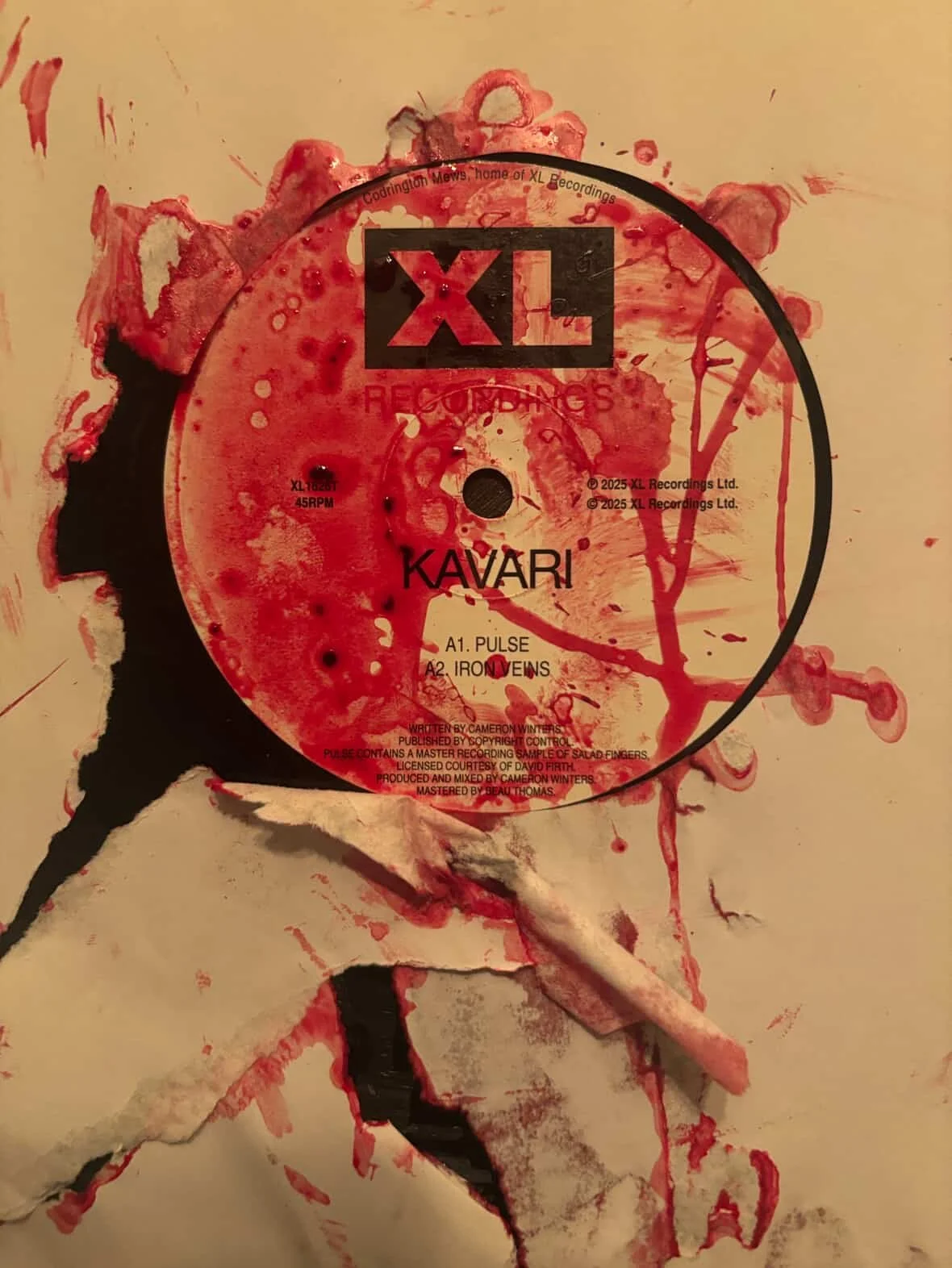
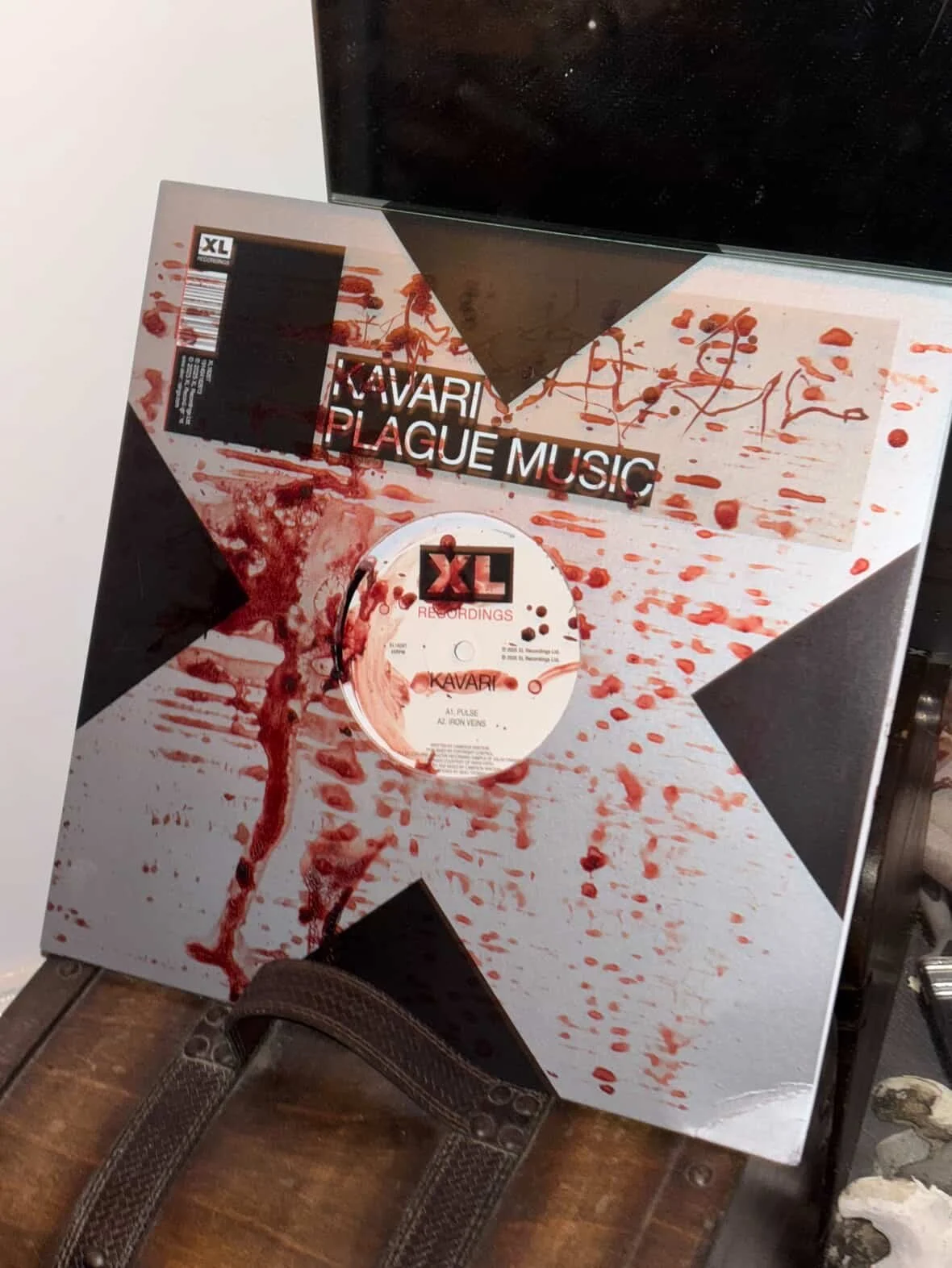
alisha: You often use your own bodily fluids within your artwork. How did this start?
KAVARI: I’ve never really been into traditional ways of making art. When I was younger, I always thought I was really bad at drawing or painting, I just don't seem to have the eye for it. I always had this desire to make some type of physical or visual art that had the same feel as my music, but I didn't know how to translate that. Then, I found out about an artist called Franco B. A lot of his work is about him being a gay man during the AIDS crisis, and one of the first pieces I saw of his was where he put cannulas in both of his arms and walked down a runway of white paper. It was meant to make a statement about society thinking queer people were dirty and that you could catch AIDS just from being around them. Putting on this show where he's spraying his blood everywhere on a fashion runway really made me think, damn, I didn't even realise you could make work like that. So, I researched more into different artists who used blood or other human materials, like skin. Throughout history, there have been artworks made out of human skin, or within different cultures, decorative pieces made from bones. I just started messing around with this idea, and over time, it just kind of developed and built into a staple of all my pieces. I feel like it's the most raw thing that I can put into a visual that I have at my disposal.
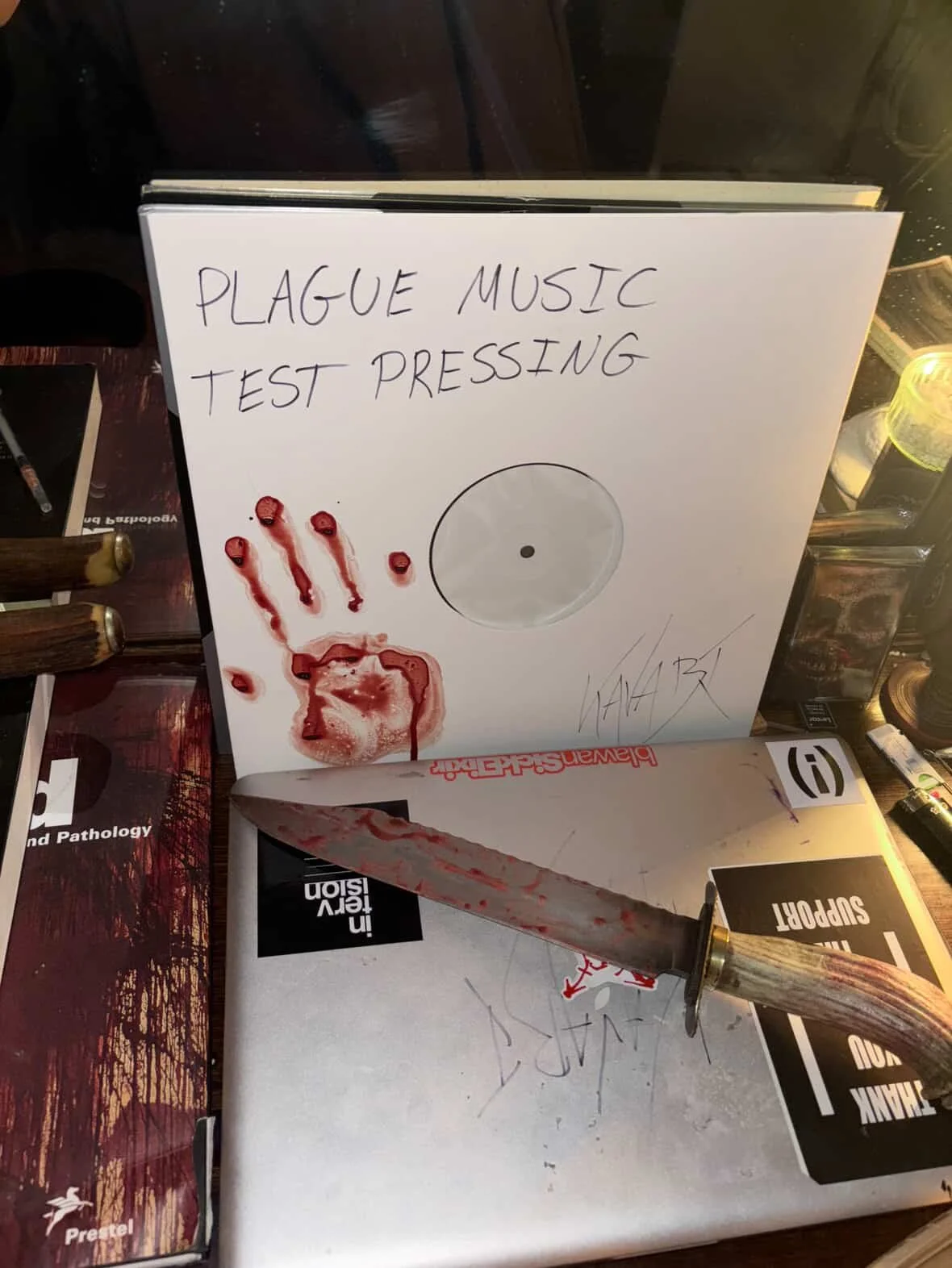
a: Yeah, I've seen that art during the 60s, where people would make projections of their piss or cum, and it creates these beautiful forms. Even though it's supposed to be the most grotesque thing that we can make, it’s a part of all of us, every human. I love that you've used it for your album artwork for Plague Music. I know you posted the other day about releasing a couple that actually would have your blood on it. Are you still going to do that?
k: Yeah, I think so. That would be amazing. I'd probably have to do it privately, or I'm not sure if XL could really approve or promote it because of legal biomedical reasons. But I have a few of them in my studio and flat. I feel bad, I don't want to keep them to myself.
a: Maybe an obvious question, but since it's called Plague Music, what was the concept behind the EP? I feel like we're kind at the peak, in the middle of a plague, and this is the soundtrack to the infection.
k: Yeah, it was kind of this take on EDM and electronic dance music. It’s very happy or escapist. I’d always get annoyed on SoundCloud when I'd find a cool song, but it would have a joke or a meme in it, like a really good gabber track, but then there would be a ‘bruh’ just before the drop or something. It happens too often. Electronic music is such an intense genre. The sounds are so intense, they're played on big speaker systems to mass numbers of people. Why does it always have to have this kind of tongue-in-cheek thing? I feel as though it's subtracted from itself because you can have a really intense moment, but you're almost scared to be at the intensity or meet the intensity, so you have to slip in jokes and memes. I had that first concept on my EP Suture. I was sampling American Horror Story, Fight Club, different interviews about mental illness, and different sound effects of coughing and breathing. So Plague Music became the development of this concept, and I was thinking about how I can refine it and push it harder.
a: I feel like we've become such a post-ironic society. Irony layered upon irony that people are afraid to just like what they like and just say it with their chest because they’re scared to be cringe. I do feel like we'll have a return to sincerity in some ways because everything's gone too ironic. As you said, everything is a meme layered within a meme.
k: I do like humour [laughs] but it’s very dry and sarcastic. It's a thing that I see magazines say about me a lot. I always say that you can joke around, having quite a slapstick approach to life, but also take things seriously.
a: Yeah, definitely. I’m from the North, so I do think that’s where my dry sense of humour has come from. Do you feel that too, being from Scotland?
k: Yeah, a lot of my family originally are from Liverpool. I think my grandparents live there, and I spent the first four or five years of my life there. Both my parents are from Merseyside, so I’ve also had that exposure to insult-based humour. Then going up to Scotland, they have this constant banter where if you're not from the area or you don't know it, it can come across as quite, not aggressive, maybe confrontational. So, definitely growing up around it has desensitised me. Magazines will often start by asking like oh tell us about your amazing adventures, and I’m like I’ve been sleeping. They think I'm being cold and pretentious, but it’s not the case.
a: [laughs] I feel like a lot of people do take themselves too seriously. Especially in the creative industry, just because you make serious work doesn't mean that you have to be serious all the time.
k: I think that's kind of a plague on people, that nobody can seem to fathom that two things can exist at once. Like you can be this and also this.
a: Absolutely. At what point did you kind of realise that you wanted Plague Music to have that name?
k: The name came before any of the tracks. I remember even before XL had approached me, I was thinking about my next EP or my next project. One idea that kept bouncing around in my head was that I’d seen different artists calling their album or EP something categorising a type of music, so I thought Plague Music sounded cool. It also related especially to post-COVID, and it really just kept ringing in my head. Then, when XL approached me in September 2024, that’s when I started to flesh it out and gave them the demo for Iron Veins.
a: Even though I feel like COVID was described as unprecedented times, throughout history, we have seen it before. So it's interesting to see people coming out of it now, six years later. I feel like your music breaks this emptiness that we've had for so long. With everybody being so siloed, it’s almost like you’re kind of throwing it back in people's faces. I don’t know if you’ve heard of this, but I found this out the other day, that during the Middle Ages, there was this thing called Charivari, where people would make the loudest, most destructive noises as people would walk through the streets to shame them, if they’d committed a crime. I feel like, because of your name and the way your music operates, it’s kind of similar in the way all these noises come together.
k: I feel like that also relates to a lot of what I was trying to do when I got into the music industry. My approach to it was like, oh, it's all trash, everyone's a narcissist, and everyone's just trying to be out for themselves. So I came in with this approach of I'm going to shame people with these loud noises.
a: It needs to be done, though. I think we’re also going to see much more of a mob mentality coming back, too, in the way that people can't trust institutions, so they’re reverting to crowd-sourcing opinions.
k: I see that already for sure. I think that’s where it's given me this apathy towards the world and what has pushed my pessimistic worldview. I thought that with the internet and technology, it would bring people together and people would be more aware, but it's the complete opposite. It’s insane that people can't really see nuance anymore, it's like people will see something and just run at it and be like oh my god, evil, evil! Almost like the witch trials.
a: Yes, this is what I've been saying for so long! I feel like the past couple of years, it really does feel like a mirror of the witch trials so much.
k: Especially because everyone is struggling. Even if you're super wealthy, you still have that existential thing in your head of I'm gonna die one day. What is the meaning of life? What is the purpose of my being here? Am I good? Am I bad? What does good and bad mean? Everyone's on this kind of equal playing field mentally, where we're all very scared, very confused. Nobody really knows where things are going. Everyone wants things to go in a good way, but then nobody really knows how to make it go that way. You've got the super rich people that are clustering together and doing the most insane stuff and trying to scapegoat people and use politics in these weird ways, then you've got working-class people down at the bottom that are suffering the consequences but then also dividing into the mobs and being like: oh well it's immigrants that are the reason my life is bad, oh no it's trans people, oh no its gay people. It’s literally like the eternal arms twisting around each other and pointing.
a: Especially with corporations as warlords, and there's the state monopoly of violence. We’re in this techno-feudalist system, but it’s like the peasants in the Middle Ages, when they started to invent technology that would help them, like the printing press or machines to help labour, the people in charge started to actually take notice of the quality of human labour and started to pay them properly. I feel like that was kind of an era when rich people used to contribute to society in a more meaningful way than what we've got now.
k: Especially, I think, back then, you could pay to have a military and God, but at the end of the day, if you were a bad person, you would always have someone gunning for you, and it was a lot harder to protect against that. Whereas now, with the way the world's set up, a billionaire can literally just boost to anywhere they want to go, and they have legal teams under them that they can just throw cash at, and nobody will ask questions. They have this extra high castle that they're able to stand in than previously, because you used to be able to scale the walls, whereas now the walls are floating.
a: Do you have any predictions for what this year is going to look like?
k: I think my optimistic view would be that people finally hit their breaking point, where you've seen people have riots, or people have just completely chucked out their governments, and it's worked, they've had some improvements. I really, really hope that's the direction that we can move in, where it doesn't have to be this apocalyptic bloodshed of society basically resetting. But also, I can see a future where that's possible, where there are people in government who do have good intentions and do want the best for people. They just aren't the ones that are hungry for power, and they're not the ones that are trying to like step their way to the top. I think it was Alex Jones. I remember seeing a video of him ranting about what he thinks is going on in the world. He was saying you've got all these evil people, and evil people crave power, so they're always going to try and destroy humanity. But then you’ve the good ones and the good ones will always win, but they never want to organise. So we just need to wait until the good ones eventually get organised, and then evil will be defeated because it's always defeated. I remember seeing that and thinking I pray that's the case. The flip side of that is I just see the future doing what it has done over the past 10 years, where it's just been this gradual creep of everything getting a little bit worse, where everything's a little more expensive. Health care gets worse, and you can't get appointments and medications. Everyone gets more stupid and more reactive, and to be honest, it's actually probably scarier to think that this year will just be another footstep into that.
a: I really agree with you, and I really hope that it does turn around, but also, it's that gradual decline that feels like everything is slowly sinking.
k: I think as well, there’s this issue with every country and every institution. I remember seeing a really interesting video on TikTok that basically spoke about how money is the physical manifestation of guilt. People started using money as a way to say, I haven't given you anything, but here's something. That kind of devolved into what we have today, where it's this kind of absolute mayhem of money isn't really anything but everyone's in debt, and everyone’s in debt to each other, but nobody has the money to pay, so it’s this downward spiral of where is the money going and where's it coming from? No government or no group of people wants to acknowledge the fact that their country has done some really bad things, like America is literally new age Nazis. Even though you can change it, both sides are like, no, there's no changing it, everything must be destroyed and be my way. Which makes me think, or maybe you could just admit that America's founded on very bad things, and we could make it a better country, and the same with every country, honestly. England is no better.
a: I was going to ask you as well about symbolism from the Middle Ages, too. For example, the Wheel of Fortune, which is about what goes up must go down, and then there was Memento Mori, which was around realising that everyone's going to die eventually. So, are there any symbols or topics from that time that interest you?
k: The main one for me is magic and alchemy. That's always been a major fascination of mine. Anything to do with magic, the occult, grimoires, the paranormal, anything spiritual. I think Grimoires are really interesting during that time, as well as that whole concept of alchemy, turning lead into gold. I feel as though it's quite telling, it’s reflective of our time now, where we're trying to do the same. Everyone’s looking for the solution to get the bad to the good. We were also doing things in more magical ways. There are no specific symbols for me because that era had so much, it's hard to pick out one.
a: That just made me think of the new music video. This is a really bad segway, but because it was filmed on an infrared camera, it does look, for lack of better terms, magical. How did you and Nova work together on that? It’s one of the best music videos I've seen in such a long time, and I'm not just saying that to kiss your ass.
k: [laughs] Nova and I have known each other for years. We found each other on Instagram, we just really liked each other's aesthetics. At first, we were very shy about it. Over time, it kind of grew into this really nice friendship where we have such an identical artistic vision and inspirations and everything, that when it came to making that music video, I didn't even ask any questions, I was just like, Nova, here you go, here's the funding, just work your magic. I didn't really see anything other than a couple of mood boards, but I trusted her so much with it that I just showed up for the shoot, shot it and then got it back and was like, wow!
a: That's amazing to have that creative intuition and trust with someone, that’s so special.
k: We have a really cherished friendship, and I feel like we have such a sisterhood.
a: One thing I always ask people when I chat to them as well is, what was the last dream that you had? Or, what was the last one that you can remember?
k: I think the last dream that I remember was a couple of nights ago. I actually have really intense dreams constantly. I wake up in the morning, and I feel like I've just been pulled out of a video game. In this dream, everyone was messaging me about my ex, saying we needed to get away from each other. But not for any real reason, more just that it was a warning.
a: Those dreams always spin me out when it's about messages, because sometimes I wake up and I'll check if I did actually send or get that message.
k: A dream that has remained since I was a kid has been zombie apocalypses. Every single dream I have, even if it's just a dream of me going to a coffee shop, will mean me going into a coffee shop in a zombie apocalypse. It's an overarching narrative, and like I've tried to work it out so many times and spoken to therapists about it and my parents. It’s not always bad, it doesn’t necessarily make every dream a nightmare. There's just always this element of zombies, or living within an apocalypse.
a: Yeah, I have really immersive dreams like that, and I was going to ask you as well if you ever lucid-dreamt or had sleep paralysis?
k: I’ve been able to lucid dream quite a few times, and I do dream really heavily, so I normally remember my dreams, but I've never had sleep paralysis. I kind of want to because everyone speaks about it, and I want to see what it’s like for myself!
a: That’s your manifestations for this year, to have sleep paralysis.
k: Absolutely.
Buy tickets to Kavari’s London show here
Follow Kavari here
Follow dreams here